

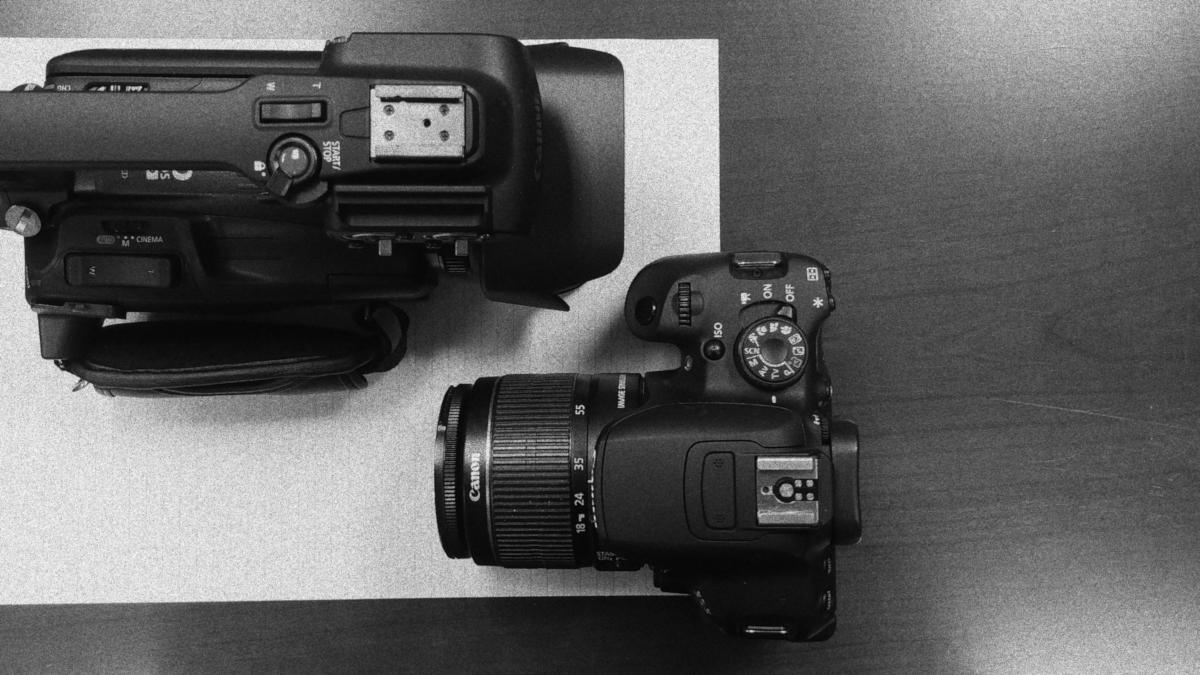
Back in film school it seemed a given that DSLRs were the tool of choice if you wanted the best picture quality for your project. So, when it came time to register for equipment those who showed up last ended up with one of the leftover ENG camcorders. Of course, that somehow ended up being me. I felt I had been given the short end of the stick with what was essentially just an upgraded version of the DVC camcorders that I had used in high school. However, as I became more acquainted with the unloved gear, I grew to love what these fine pieces of tech had to offer. In this defense of ENG camcorders, let’s observe the pros and cons of both ENG camcorders and DSLR cameras.
DSLR Pros
In order to understand the popularity of DSLR cameras in use in video production we have to understand what makes them good in the first place. A DSLR is the digital evolution of the film-based single lenses reflux cameras of old. The “SLR” in “DSLR” specifically means that you are able to see exactly what you’re shooting though a single lens. A DSLR camera can be broadly characterized by but are not limited to having a large digital sensor, interchangeable lenses, and a general theme of modularity.
Having a large digital sensor is probably the most important and distinguishing aspect of the DSLR camera. A large sensor affords the camera the ability to use large pixels that can capture more photons of light. This means you can use the camera in less than ideal lighting scenarios and still get a good image. Also, with a large sensor, depth of field effects are more easily achieved. This means you can get a professional looking blurred background in more scenarios even if you’re constrained by your lens or location.
DLSRs are also typically equipped with an interchangeable lens system. This is highly appealing to creatives looking for a distinguished look as you can pick and choose your glass as you work. If the situation asks for a shorter lens, you can bring one with you in your camera bag. Prime lenses with a fixed focal length can sometimes get you a brighter image if you don’t need to change your focal length. Also, with lens adapters you can reach across different lens ecosystems. I’ve even seen adapters that can convert the retro C mount lenses to a more modern lens mount type if you’re looking for a retro look.
Lastly, DSLRs are more modular in general. It’s not uncommon for the most popular DSLRs to have third party cages available for them. With a well-equipped cage you can attach various equipment such as mics, lights, monitors, and even poles with focus pullers on them. I’ve also seen elaborate shoulder mount rigs for shooting dynamic shots in the field. In short you can make your rig as lightweight or as feature packed as you wish.
DSLR Cons
Probably one of the most irritating cons with DSLR cameras is the prevalence of low-quality preamplifiers. With a low-quality preamp, the audio in your recordings will have an annoyingly high noise floor. The noise floor on some DSLRs are so high that I don’t bother using them in production anymore as my main sound recording device. As a result, you will have to acquire a separate sound recorder and sync the audio in post-production. This means extra work in post and also the need to keep good notes when filming. This may be okay for studio work but, I find it unacceptable for work in the field.
This leads me to another problem with DSLRs in video work: the large amount of support equipment required. Although DSLR’s modularity and interchangeable lenses give you a lot of creative choice they can be a hassle when you have to carry and keep inventory of many separate parts. If you’re planning to shoot with a DSLR you can count on bringing a couple of lenses and sound recording equipment with you too. You could in theory only bring what you need but, as I found out, what you expect to happen on a video shoot and what actually happens on a video shoot can vary greatly.
Lastly, DSLRs are not suitable for filming events or anything that requires long uninterrupted shots. Due to tax laws DSLRs are not able to record for longer than 30 minutes even if your battery and SD card file system supports it. Also, most DSLRs are unable to be powered off of the grid so you’re also limited by the health and longevity of your battery. Some DSLRs, due to their large sensors, can have problems overheating when filming for long periods of time too.
ENG Pros
Over the years, I have found that ENGs have proved their worth to me in many ways. The electronic news gathering camcorder or simply ENG for short is a type of camcorder that is designed to be used in professional news instillations. Since the distinction between a camcorder and a camera is mostly non-existent today, the main characteristic that a camcorder has that a camera does not is that it can record movies for longer than 30 minutes without interruption. ENGs ensure long duration recording in more than just software, though. Virtually all ENGs that I have come across in my tenure as a video professional has had a DC in barrel jack that can supply the camcorder with power indefinitely via power off the grid. This combined with their small heat efficient sensors mean that they can record for as long as their SD card can hold. The ENG camcorders that I use on a daily bases even have two SD card slots that can relay recording from one slot to the other without interruption.
Another benefit that ENG camcorders have over DSLR cameras is that ENG camcorders almost always have reliable and well-built audio hardware. The preamps that are in the ENG camcorders that I use on a daily basis have a noise floor that is nearly undetectable even with a compressor which is impressive for a camcorder on the lower end of the price spectrum. Furthermore, the XLR inputs can take either mic level, line level, or can even supply phantom power so they are useful in a myriad of situations that I may find myself in. The software of the camcorder also lets me do basic channel remapping so I can establish a safety channel for fixes in post-production. This is all to say that I can be rest assured that I am capturing the best possible audio in the field with a minute amount of work and gear.
ENG camcorders also benefit from a simplified lens system. Typically, ENG camcorders come with a high-quality lens built into their design. In addition to being built with high quality glass, these lenses have zoom factors that are suitable for use in sports or most other situations that require zooming into a distant subject. The quality of the zoom motion with the lenses built-in ENG camcorders is also very good since they provide a silent and variably controlled experience through their digital zoom rocker.
With the high-quality audio hardware and simplified lens system built into the body of ENG camcorders they provide an all-in-one experience that a DSLR just simply cannot provide. This means that you can build up your camera an ensure a quality recording in a fraction of the time. Also, the all-in-one design of the ENG camcorders allows you to pack less support equipment. With less support equipment you can carry the camera further distances with less exertion on your body. I know through personal experience that I have been able to shoot video in more remote locations than I could otherwise with a DSLR camera.
ENG cons
Of course, ENG camcorders also come with some minor disadvantages to DSLR cameras. First, while ENG camcorders can come in varieties with interchangeable lenses, those models are far more expensive than even the most premium DSLR cameras. This means that more often than not, you’re stuck with the lenses that your camcorder came with. You won’t be able to change the style of your cinematography and you won’t be able to swap out a lens if it breaks.
Also, ENG camcorders come with a smaller sensor than DSLR cameras. As a result, you’re not going to achieve the low light performance that DSLR cameras can easily boast about. In addition, it’s more difficult to achieve the DOF effects that clients have grown to expect.
Conclusion
Although they may seem outdated and large, the ENG camcorder has found itself to be my favorite tool for video production. Of course, photographers may enjoy DSLRs for photography work but, as a video professional I find the ENG camcorder more useful for my needs than a DSLR. More times than not I find myself reaching for an ENG camcorder when I need to get the job done. However, as technology advances and as the lines between camcorders and cameras blurs, I feel this may change in the near future. What are your experiences with ENG camcorders? Do you disagree and believe that DSLR cameras are suitable for both photography and video work? Be sure to reach me at my contact page if you have any inquires or leave a comment in the comments section below.
 Ricker Video